CARE study reports complete regression of liver cancer in a child treated with novel immunotherapy
Lea este artículo en español al final de la versión en inglés.
A new report in the New England Journal of Medicine by researchers at Baylor College of Medicine, Texas Children’s Hospital and Seattle Children’s describes a complete regression of hepatoblastoma, the most common pediatric liver cancer, in a 3-year-old treated with a novel immunotherapy. The patient is enrolled in the CARE study (NCT04715191), a first-in-human, Phase 1 trial evaluating glypican-3-specific chimeric antigen receptor (GPC3-CAR) T cells armed with interleukin-15 and -21 (IL15 and IL21).
The child initially presented with a large primary liver tumor and metastases in the lungs. Prior to enrollment in the CARE study, the patient was treated with three lines of chemotherapy and underwent complete resection of the primary liver tumor and two lung metastases. His cancer was no longer responsive to chemotherapy, and a new lung metastasis recurred after surgery when he was enrolled on the CARE study.
From lab bench to bedside
The immunotherapy was engineered from the patient’s own cells at the Good Manufacturing Practices laboratories at the Center for Cell and Gene Therapy at Baylor using two vectors: one encoding the second-generation GPC3-CAR and the second encoding IL15, IL21 and the inducible caspase 9 safety switch, which Center for Cell and Gene Therapy investigators previously showed controlled CAR T expansion.
Two infusions were administered eight weeks apart in the outpatient setting.
A partial response was observed after the first infusion, and imaging showed complete resolution of the metastatic disease after the second infusion. No dose-limiting toxicities or cytokine release syndrome occurred. Complete regression continues one year after treatment.
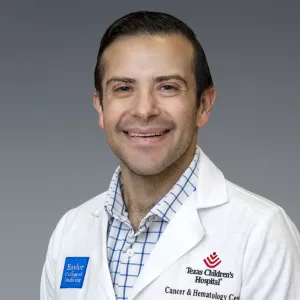
“This case demonstrates that a durable complete response in a chemotherapy-resistant solid tumor can be achieved entirely in the outpatient setting without systemic toxicity,” said first author Dr. David Steffin, associate chief of cellular therapy and bone marrow transplant at Texas Children’s and associate professor of pediatrics – hematology and oncology in the Center for Cell and Gene Therapy at Baylor.

“This study provides evidence that these novel CAR T cells may be a safe and effective modality for hepatoblastoma and highlights the need for further assessment in patients with GPC3+ solid tumors,” said corresponding author Dr. Andras Heczey, principal investigator at Seattle Children’s and professor of pediatrics in hematology-oncology at the University of Washington School of Medicine. Heczey was at Baylor and Texas Children’s at the time of research.
Other authors who contributed to this work include Amy N. Courtney, Michelle Choe, Nisha Ghatwai, Magdalena Abigail Esparza Cerda, Ramy Sweidan, Rajdekar Dhanashree, Huimin Zhang, Natasha Lapteva, Zhuyong Mei, Bambi J. Grilley, Leonid S. Metelitsa, Helen E. Heslop and Malcolm K. Brenner. They are affiliated with one or more of the following institutions: Baylor College of Medicine, Texas Children’s Hospital, Center for Advanced Innate Cell Therapy at Texas Children’s Cancer Center, Center for Cell and Gene Therapy, Dan L Duncan Comprehensive Cancer Center, Seattle Children’s Hospital, and the University of Washington.
See the publication for a full list of funding sources for this work.
By Molly Chiu
Follow From the Labs on X, BlueSky and Instagram!
Would you like to receive From the Labs via email?
Follow this link.
En español
El estudio CARE reporta una regresión completa del cáncer de hígado en un paciente the 3 años tratado con una inmunoterapia novedosa
Un nuevo estudio publicado en el New England Journal of Medicine por investigadores de Baylor College of Medicine, Texas Children’s Hospital y Seattle Children’s describe una regresión completa del hepatoblastoma, el cáncer de hígado pediátrico más común, en un paciente de 3 años tratado con una novedosa inmunoterapia. El paciente está inscrito en el estudio CARE (NCT04715191), un ensayo clínico de Fase 1, primero en humanos, que evalúa células T con receptor de antígeno quimérico específico para glicopicano-3 (GPC3-CAR) potenciadas con interleucinas 15 y 21 (IL15 e IL21).
El menor se presentó inicialmente con un gran tumor hepático primario y metástasis en los pulmones. Antes de incorporarse al estudio CARE, fue tratado con tres líneas de quimioterapia y se sometió a la resección completa del tumor hepático primario y de dos metástasis pulmonares. Su cáncer dejó de responder a la quimioterapia y una nueva metástasis pulmonar reapareció después de la cirugía, momento en que fue inscrito en el estudio CARE.
Del laboratorio a la cabecera del paciente
La inmunoterapia fue desarrollada a partir de las propias células del paciente en los laboratorios de Buenas Prácticas de Manufactura del Center for Cell and Gene Therapy de Baylor, utilizando dos vectores: uno que codifica el GPC3-CAR de segunda generación y otro que codifica IL15, IL21 y el interruptor de seguridad de caspasa 9 inducible, el cual investigadores del Center for Cell and Gene Therapy habían demostrado previamente que controlaba la expansión de las células CAR T.
Se administraron dos infusiones con ocho semanas de diferencia en un entorno ambulatorio. Se observó una respuesta parcial después de la primera infusión y las imágenes mostraron una resolución completa de la enfermedad metastásica después de la segunda. No se presentaron toxicidades limitantes de la dosis ni síndrome de liberación de citocinas. La regresión completa se mantiene un año después del tratamiento.
“Este caso demuestra que una respuesta completa duradera en un tumor sólido resistente a la quimioterapia puede lograrse completamente en un entorno ambulatorio y sin toxicidad generalizada,” afirmó el primer autor, Dr. David Steffin, jefe asociado de terapia celular y trasplante de médula ósea en Texas Children’s y profesor asociado de pediatría, hematología y oncología en el Center for Cell and Gene Therapy de Baylor.
“Este estudio proporciona evidencia de que estas novedosas células CAR T pueden ser una modalidad segura y eficaz para tartar el hepatoblastoma y pone de relieve la necesidad de una mayor evaluación en pacientes con tumores sólidos GPC3+,” afirmó el autor líder, Dr. Andras Heczey, investigador principal en Seattle Children’s y profesor de pediatría en hematología-oncología en la University of Washington School of Medicine. Heczey estaba en Baylor y Texas Children’s en el momento en que se realizó la investigación.
Otros autores que contribuyeron a este trabajo incluyen a Amy N. Courtney, Michelle Choe, Nisha Ghatwai, Magdalena Abigail Esparza Cerda, Ramy Sweidan, Rajdekar Dhanashree, Huimin Zhang, Natasha Lapteva, Zhuyong Mei, Bambi J. Grilley, Leonid S. Metelitsa, Helen E. Heslop y Malcolm K. Brenner. Los autores están afiliados a una o más de las siguientes instituciones: Baylor College of Medicine, Texas Children’s Hospital, Center for Advanced Innate Cell Therapy at Texas Children’s Cancer Center, Center for Cell and Gene Therapy, Dan L Duncan Comprehensive Cancer Center, Seattle Children’s Hospital y la University of Washington.
Consulte la publicación para obtener una lista completa de las fuentes de financiamiento de este trabajo.
###