Does seasonal affective disorder exist in the summer?
People often experience winter blues in colder months when the days are shorter, leading to seasonal affective disorder (SAD). But how do the warmer months affect overall mental health? With climate change, earth is undergoing extreme climate and weather events, ranging from snowstorms to hurricanes. Extreme heat leads to irritability.
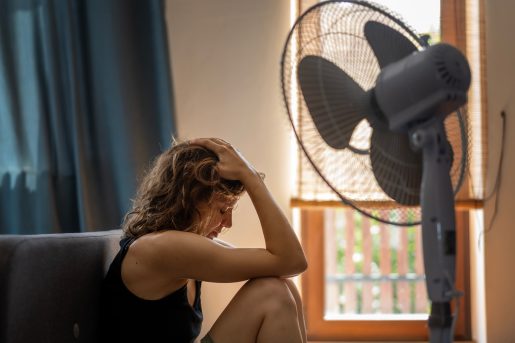 “The fact that we are exposed to more extreme things has to be taken into account, not the fact that it’s just seasonal, because it’s not seasonal anymore,” said Dr. Nidal Moukaddam, professor in the Menninger Department of Psychiatry and Behavioral Sciences at Baylor. “With increasing temperatures, there is an increase in trauma. People become more violent, and there is an increase in suicide and mood symptoms.”
The effects of climate change might lead to one’s mood feeling off and one step closer to irritability. While not everyone will present violence, irritability is significant and translated to healthcare outcomes. Heat typically does not lead to depression. It might make one feel tired or hyper, but it will not lead to sadness like the lack of sun does during the winter.
“This is quite the opposite of the SAD we’re used to, which is a sad or depressed mood with the absence of sun. It’s the feeling of something unpleasant that could translate into agitation and irritability,” Moukaddam said.
With feelings of irritability, people often sleep less or have inconsistent sleep patterns, especially if their air conditioning is not consistent. The change in temperature when going in and out of places or being stuck in traffic can lead one to be temperamental. People might display more road rage and less kindness.
Those irritated with the heat might choose to stay home and avoid leaving the house, which could link to potential depression. People often stop exercising, especially if their preferred exercise takes them outdoors, unless they go to a gym with air conditioning.
“The heat will effectively change your behavior, and by changing your behavior, it might force you to isolate or be stuck inside and sad,” Moukaddam said. “It doesn’t fit the traditional parameters of SAD, but it has the markings of SAD.”
A change in environment might solve agitation. One who takes a break elsewhere with better weather might react positively to the change, but if someone is depressed, the anhedonia, or inability to find pleasure, will persist, and they will not enjoy themselves even in a temperate climate.
Anyone’s mood could be affected by the heat, but some people might carry a greater impact:
- Someone that is fragile or has mental health issues.
- Someone who is temperamental by disposition or personality.
- Someone who is forced to be out in the heat.
- People with physical issues.
“Sometimes your mood might be fine, but you end up with physical symptoms that make you short-tempered and cranky. The vulnerability aspect is mental and physical in this case because heat does so much to us physically,” Moukaddam said.
Moukaddam recommends people plan for heat instead of passively enduring it. If summer months make one more confined, they should adjust. Minimize heat exposure by going out earlier in the morning or in the evening. Change physical exercise patterns by walking during cooler hours, walking indoors or swimming. Do not skip exercise.
“If you can plan it, you can manage yourself better, and your mood can be stable,” she said.
If this turns into depression, seek treatment. Mild-to-moderate depression does not need to be treated with medication immediately.
“Psychotherapy is the cornerstone. Get what’s bothering you off your chest, think of ways to deal with it with your therapist and from there, progress into planning for the future so this doesn’t happen again. If it persists, then your therapist might recommend medication,” Moukaddam said.
By Homa Warren