Skip to content
Thursday, July 30, 2026
Latest:
  • A closer look at brain tissue vulnerability in neurological disease
  • Fuel Your Adventure: Healthy Road Trip Snack Ideas
  • Global surgery in action: Resident expands training, cancer care, and advocacy worldwide
  • New imaging tools to listen in on the brain’s ‘electrical whispers’
  • What makes a good walking shoe?
Baylor College of Medicine Blog Network

  • Home
  • Momentum
    • About Momentum
    • Resources
    • Contributors
      • Taylor Barnes
      • Dana Benson
      • Molly Chiu
      • Julie Garcia
      • Graciela Gutierrez
      • Anna Kiappes
      • Aries Payne
      • Andy Phifer
      • Homa Warren
      • Melissa Tucker
    • Contact Us
  • From The Labs
    • About From the Labs
    • Follow From The Labs on Twitter
  • Policywise
    • About PolicyWise
    • Follow @BCMEthics on Twitter
  • The Stitch
    • About The Stitch
  • Progress Notes
    • About Progress Notes
    • Progress Notes Editors
    • Connect With Us
  • bcm.edu

ACTL6A

From The Labs

A new mechanism of cisplatin resistance in cancer, and how to reverse it

April 22, 2021 ACTL6A,  cancer resistance to therapy,  cisplatin,  DNA repair,  epigenetic chromatin remodeling,  panobinostat,  Research

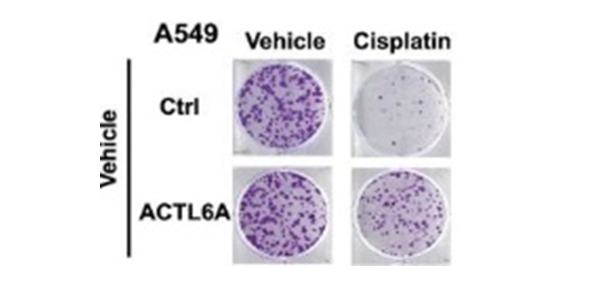
ACLT6A overexpression confers cancer cells resistance to cisplatin, and researchers found a way to reverse it.

Read More

From the Labs: Image of the Month

two distinct neuronal populations in separate compartments of a microfluidic device. On the left, neurons express the 4R tau form (pink), which is associated with toxicity in Alzheimer’s disease, while on the right there are neurons from healthy individuals expressing normal tau (blue). In the central microgroove region of the device, neurons extend axons between the compartments. From the Labs: Tau travels between neurons

Healthy Habits: A DOC-umentary Series

https://www.youtube.com/watch?v=SlNiMWHUhbc

Archives

Search

©1998 - 2023 Baylor College of Medicine®
One Baylor Plaza, Houston, Texas 77030
(713) 798-4951