Dr. Kenneth Liao completes 1,000th robotic heart procedure, advancing the future of cardiac surgery at Baylor
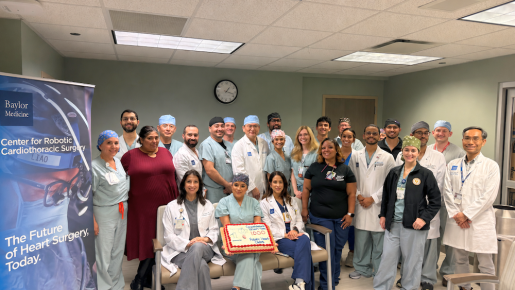 Baylor Medicine is celebrating a milestone in the advancement of cardiac surgery. Dr. Kenneth K. Liao, professor and chief of the Division of Cardiothoracic Transplantation and Circulatory Support at Baylor College of Medicine, has completed his 1,000th robotic heart procedure at Baylor St. Luke’s Medical Center. The achievement marks a major moment for Baylor’s robotic cardiac surgery program. It reflects years of surgical innovation, multidisciplinary teamwork and a continued commitment to offering patients state-of-the-art, less invasive options for treating complex heart disease.
Since joining the Texas Heart Institute at Baylor College of Medicine in 2019, Liao has led the development of one of the fastest-growing robotic cardiac surgery programs in the country, now among the nation’s leading programs. He has performed robotic heart procedures for nearly two decades, adopting the technology early and helping expand its use in complex cardiac operations.
For Liao, the milestone represents far more than a number. “Every robotic heart procedure represents a patient who trusted us with their care and a team that came together to deliver the best possible outcome,” Liao said. “Reaching 1,000 procedures is meaningful because it shows how far robotic cardiac surgery has come and how much more is possible when experience, technology and teamwork come together.”
Robotic heart surgery allows surgeons to perform cardiac procedures through small incisions, often avoiding the need for a traditional sternotomy, where the breastbone is divided to access the heart. For appropriately selected patients, this minimally invasive approach may reduce surgical trauma, pain, blood loss and recovery time.
At Baylor Medicine, Liao and his team use advanced robotic technology to treat a wide range of cardiac conditions, including mitral valve disease, tricuspid valve disease, coronary artery disease, atrial fibrillation procedures, select aortic valve procedures, congenital heart defects, benign cardiac tumors, complex reoperations and heart transplantation in select adult patients. Liao and his team offer almost all heart procedures robotically, including mitral valve repair and coronary artery bypass grafting. Some procedures can be performed on a beating heart without the need for a traditional heart-lung machine, offering a less invasive option for patients who may otherwise require open-heart surgery.
The 1,000th robotic heart procedure builds on a series of major milestones for Liao and Baylor. In 2025, Liao and his team performed the first reported fully robotic heart transplant in the United States, a breakthrough that avoided opening the chest and represented a major step forward in transplant surgery. The patient, who had advanced heart failure, received a donor heart through a minimally invasive robotic approach.
“This milestone is a testament to Dr. Liao’s vision, expertise and dedication to advancing the field of cardiac surgery,” said Dr. Todd K. Rosengart, interim executive vice president of clinical affairs and chair of the Michael E. DeBakey Department of Surgery. “Baylor Medicine is proud to be home to a program that is helping redefine what is possible for patients with complex heart disease.”
While robotic surgery often is associated with technology, Liao emphasizes that the robot does not perform the surgery. The surgeon remains fully in control, using the robotic platform as an advanced tool that allows for small incisions, high-definition 3D visualization, enhanced precision and improved dexterity inside the body. Behind each successful case is a highly specialized team, including surgeons, anesthesiologists, nurses, perfusionists, advanced practice providers, operating room staff, cardiologists and hospital leaders who help support patients before, during and after surgery.
“Reaching 1,000 robotic heart procedures is something the entire team can be proud of,” said Maria Pinero, nurse practitioner in the Division of Cardiothoracic Transplantation and Circulatory Support. “These cases require preparation, trust and coordination from every person in the room. It is exciting to be part of a program that continues to grow while keeping patients at the center.”
For patients, the impact of robotic heart surgery can be life changing. Smaller incisions and less disruption to the chest wall may help patients return to daily activities sooner, especially those at higher risk or facing complex cardiac conditions. “I was nervous when I heard I needed heart valve surgery again for the fourth time, after previously having three other heart surgeries within a few months, but after coming to Baylor, Dr. Liao and the team explained robotic surgery as a solution and helped me feel confident in the plan,” said Ruirui Johnson. “Being able to recover with less pain and get back to my life meant everything to me.”
As the program looks beyond 1,000 procedures, Baylor Medicine remains focused on expanding access to advanced robotic cardiac care, training the next generation of surgeons and continuing to push the field forward. “The future of heart surgery is moving toward approaches that are safer, less invasive and more personalized for each patient,” Liao said. “Our goal is to continue building that future here at Baylor, one patient at a time.” The milestone reinforces Baylor’s role as a leader in robotic cardiac surgery. It highlights what is possible when academic medicine, surgical expertise and innovative technology come together to improve patient care.
By Kelsey Scott, communications associate in the Michael E. DeBakey Department of Surgery