From space missions to remote clinics: Technologies bringing care closer
Access to timely clinical insight often depends on specialists, infrastructure and healthcare systems that may not be available in remote environments, disaster settings or future space missions. Supporting human health during long-duration exploration will require technologies capable of bringing diagnostic and decision-making capabilities to the point of care.
The Translational Research Institute for Space Health (TRISH) supports a broad ecosystem of researchers and companies developing tools designed for these operational challenges, helping connect developers with clinical and real-world remote environments where technologies can be tested, refined and scaled.
One TRISH-supported space health research project, developed by PlenOptika, illustrates how technologies initially supported for space health applications have continued to evolve into widely deployed healthcare tools on Earth.
Expanding accessible vision care with PlenOptika
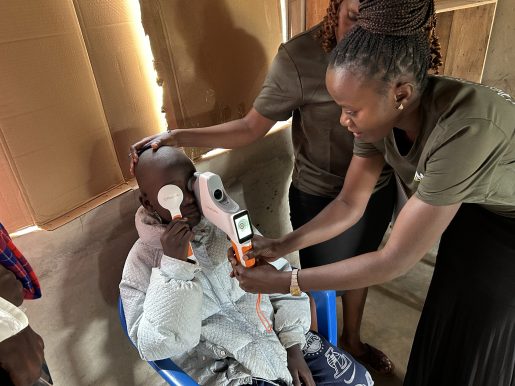
PlenOptika develops handheld, AI-powered vision diagnostic devices designed to bring eye exams directly to patients, wherever they are. The company’s work addresses a growing global challenge: an estimated one billion people worldwide lack access to the glasses they need, in part because there are not enough eye care providers and clinics to meet demand.
TRISH-supported funding contributed to the development of PlenOptika’s second-generation handheld autorefractor technologies, QuickSee Free and QuickSee Free Pro, designed to enable automated vision assessments known as objective refraction outside traditional clinical settings.
Since launching in late 2023, the devices have been deployed in more than 65 countries and measured more than 10 million patient interactions worldwide. The technology now supports vision outreach and screening programs through partnerships with healthcare providers, governments, nonprofits and global health organizations, as well as helping traditional optometry and ophthalmology clinics modernize to meet evolving patient needs.
QuickSee Free has been used in screening initiatives led by organizations including the Fred Hollows Foundation, Sightsavers and Orbis International in countries including Nepal, Sierra Leone, Mongolia, Uganda and India. The platform was also used for the Polaris Dawn mission, demonstrating its potential utility in an environment where autonomous medical technologies could be considered essential.
“TRISH inspired and supported innovation in our medical devices so they could deliver clinical quality results in the toughest conditions, which is exactly what the billion people on earth living with refractive error need,” said Dr. Shivang R. Dave, PlenOptika co-founder and CEO.
Supporting healthcare innovation for extreme environments
As space agencies and commercial partners prepare for longer-duration missions beyond low Earth orbit, technologies that support autonomous care, portable diagnostics and operational medical decision-making are becoming increasingly important.
The continued growth of TRISH-supported scientific projects with companies like PlenOptika demonstrates how early-stage space health innovation can mature into scalable tools with broader healthcare applications here on Earth. By supporting translational technologies across disciplines, TRISH aims to build the infrastructure and capabilities needed to support human health during future exploration missions while also expanding global access to care.