Growing Up Baylor: Dr. Andrea Bradford
Imagine studying, training and eventually working at the same institution during the span of your career. A special group of physicians, faculty members, researchers and staff at Baylor College of Medicine have had this unique experience.
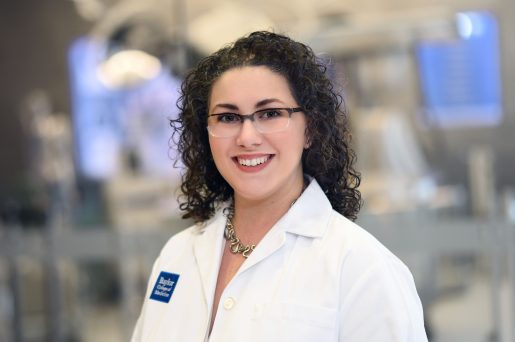
Dr. Andrea Bradford, program director of the Clinical Psychology Ph.D. Program in the School of Health Professions at Baylor, tells us how training and working at Baylor has impacted her life and career.
 Q: Did you always know you wanted to study medicine/science?
A: As a teenager, I knew that I wanted a career in healthcare. I originally thought about a career in medicine, but in college, my interests pivoted toward experimental and clinical psychology. I knew I wanted to pursue a career at the interface of psychology and medicine.
Q: Where and when did your journey with Baylor College of Medicine start?
A: I began collaborating with Baylor investigators when I was in graduate school at UT Austin. I pursued a part-time opportunity to assist faculty at IQuESt (then HCQUS) with editing grants and manuscripts. These collaborations eventually gave way to an opportunity to collaborate with several Baylor faculty to write a first-authored manuscript. These experiences influenced me to apply to Baylor for my predoctoral internship in clinical psychology. Similar to residency, clinical psychologists apply and match to sites for advanced clinical training. I arrived at Baylor in 2008 for my predoctoral internship and stayed on for a research fellowship the year afterward.
Q: What is your favorite memory from being a fellow at Baylor?
A: I loved the multidisciplinary environment and the energy of the Texas Medical Center. Early during my internship, my cohort went on a walking tour in which we learned to navigate a great deal of the medical center using a network of tunnels and skybridges. That was very convenient for the July heat but also gave us a flavor for the history and interconnectedness of BCM and the other TMC institutions.
Q: What inspired you to continue working at Baylor?
A: While I never intended to make Houston my permanent home, that changed as I spent more time at Baylor and saw what was possible in strong, collaborative teams. I had wonderful mentors who helped steer me toward opportunities that would facilitate my career development.
Q: Knowing what you know now, what you would you tell your younger self?
A: Don’t rule out any career paths just because you can’t yet see a way to make them work! Find the people who inspire you and are willing to mentor and sponsor you along your journey.
Q: What do you think makes the program at Baylor unique?
A: Baylor is part of the fabric of Houston, and vice versa. Clinical psychology training at Baylor provides learning opportunities that emerge from our location in one of the largest U.S. cities and from Baylor’s partnerships with other institutions and community organizations. In a very real sense, we get to be in many places at once by virtue of our association with Baylor.
Q: Do you have advice for current trainees?
A: Give yourself permission to evolve, but also the grace to accept your missteps and learn from them.
Q: How has sticking with Baylor programs and ultimately becoming a faculty member impacted your life/career?
A: I’ve made Houston my home. I left Baylor after my fellowship to start my career at MD Anderson, but what brought me back to Baylor were the people, the sense of opportunity, and the potential for growth. I’m doing things today I never could have foreseen. I have experienced Baylor as a place where that kind of transformation can happen.