A scarless option for thyroid surgery
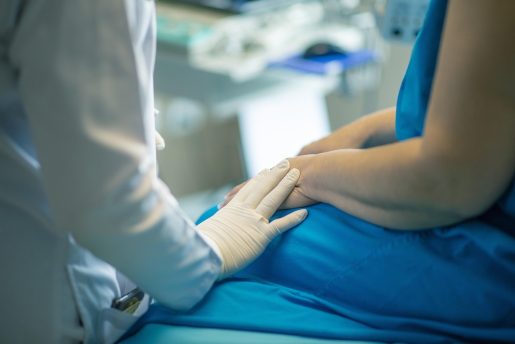 For many people who need thyroid surgery, the thought of a visible scar on the front of the neck can add anxiety to an already difficult diagnosis. Patients may be candidates for a scarless surgical option known as the transoral vestibular approach to thyroid surgery.
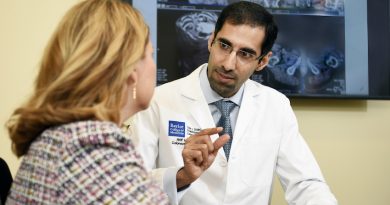
The approach allows surgeons to remove part or all of the thyroid gland through small incisions inside the lower lip. Because the incisions are internal, the procedure leaves no visible scar on the neck. The procedure is performed by Baylor College of Medicine endocrine surgeon Dr. Raymon Grogan, professor in the Michael E. DeBakey Department of Surgery. Patients are cared for by a multidisciplinary endocrine surgery team that includes Dr. Tal Yalon, assistant professor in the Michael E. DeBakey Department of Surgery, who is involved in patient evaluation, shared decision-making and postoperative care.
What is the transoral vestibular approach?
In traditional thyroid surgery, surgeons access the thyroid through an incision across the front of the neck. In the transoral vestibular approach, surgeons reach the thyroid through three small incisions inside the lower lip, using specialized instruments and a camera to safely remove thyroid tissue.
The thyroid is removed through the central incision, and the internal incisions are closed with dissolvable sutures. Since the approach avoids an external neck incision, there is no visible surgical scar.
Among surgical techniques sometimes described as scarless, the transoral vestibular approach is the only option that eliminates any external incision rather than relocating it to another area of the body.
Why patients often choose this approach
Patients often consider the transoral approach for both cosmetic and quality-of-life reasons.
The thyroid gland sits at the center of the neck, making scars from traditional surgery difficult to conceal. For some patients, a visible scar can feel like a daily reminder of illness.
“This area is right in the middle of the neck, and patients see it every time they look in the mirror,” Grogan said. “For many people, avoiding that visible reminder matters.”
Recovery is another consideration of the transoral approach. Many patients experience manageable discomfort and can return home quickly, often relying on over-the-counter pain medication after the initial recovery period.
Outcomes and safety
The goals of transoral thyroid surgery are the same as traditional thyroidectomy: safe and effective removal of thyroid tissue while protecting the voice, parathyroid glands and surrounding structures.
“For carefully selected patients, we are able to achieve outcomes that are equivalent to traditional surgery,” Grogan said.
Clinical studies have shown that the transoral approach offers similar safety and effectiveness compared with conventional open thyroid surgery for many patients. As with any surgical procedure, risks exist, but current evidence supports the approach when performed by experienced surgeons and used for appropriate candidates.
Are you a candidate?
Not every patient is a candidate for transoral thyroid surgery. A thorough evaluation is required to determine the safest surgical approach.
Patients who may be eligible include those with:
- Thyroid cancer nodules smaller than 2 centimeters.
- Benign thyroid nodules smaller than 6 centimeters.
- Benign thyroid conditions such as goiter or Graves’ disease.
- Primary hyperparathyroidism and select secondary or tertiary cases.
Each patient is evaluated individually, and treatment recommendations are based on anatomy, diagnosis and patient priorities.
“This is a shared decision between the surgeon and the patient,” Grogan said. “Often, it is not only a medical decision but a personal one.”
What patients can expect after surgery
Most patients stay in the hospital overnight and return home the following morning. Temporary symptoms may include a sore throat, mild voice changes, neck stiffness and swelling or bruising of the lower lip and chin. These symptoms typically improve within one to two weeks.
Patients are generally advised to begin with liquids on the first day after surgery, advance to soft foods on the second day and return to a regular diet shortly after. Careful oral hygiene and prescribed mouth rinses help support healing.
“Our priority is always safe and effective treatment,” Yalon said. “When we can also support patients in feeling more like themselves after surgery, that can make a meaningful difference.”
By Brittany Fisk Adiletta with the Michael E. DeBakey Department of Surgery