Protecting her future: Janice’s preventive pancreatic surgery story
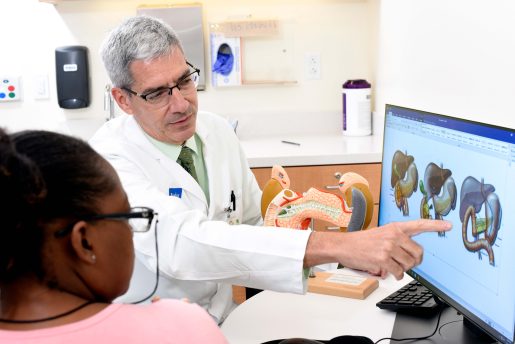 Early detection plays a life-saving role for people at increased risk of pancreatic cancer. For patients with a strong family history or concerning cysts, timely evaluation can make all the difference. Janice Ferguson, a Baylor Medicine patient of surgical oncologist Dr. William Fisher, talks about her experience – from how she discovered a cyst on her pancreas, what it was like to learn about her risks, why she chose robotic surgery, and how she recovered with the support of her care team and loved ones.
Q: Janice, how did you first learn that you had a cyst on your pancreas?
A: In 2024, I had an endoscopy, and that is when they found a cyst. They told me they would keep an eye on it. When I went back for the follow-up in 2025, they saw that the cyst had grown. My doctor wanted me to meet with a pancreas specialist, which is how I ended up with Dr. Fisher.
Q: What was the conversation like when you met Dr. Fisher for the first time?
A: I went to the appointment by myself. He explained everything about the cyst, the risks and the options I had. Because of my family history, we could either watch it for a couple of years or consider surgery to reduce the risk of pancreatic cancer.
I had a lot of questions. I was a little numb at first because I was trying to take in so much information. But he answered everything clearly. I went home and talked with my niece, who had her own questions. Dr. Fisher even set up another appointment just for us to go over every question, and I sent him a two-page list. He took his time and explained it all. That made me feel completely comfortable.
Q: You mentioned your family history played a big role. Can you share more about that?
A: Yes. My father had pancreatic cancer. My brother had pancreatic cancer. My sister had it too. All three passed away from pancreatic cancer. I have a big family with eight siblings, and we also have a history of breast cancer. So, when Dr. Fisher explained everything, I knew I needed to take it seriously.
Q: When talking about surgery, what did you learn about robotic surgery compared to traditional open surgery?
A: I honestly did not want a big incision. I know robotic surgery is the future, and it felt like the right choice. The way Dr. Fisher explained it made me trust him even more. I could tell he would only recommend something necessary and safe. I felt like I was in good hands with him and his whole team.
Q: What do you remember about waking up after surgery and your hospital stay?
A: When I woke up, the staff took such good care of me. I have a sense of humor, so I was joking around, and they joked right back. Yes, it hurt, but it was manageable with medication and support. Between the nurses, doctors and my niece, I felt like people really had my back.
I stayed in the hospital for three days. The team was wonderful. I always tell people that you need humor and a good attitude. It helps more than you think.
Q: How was your recovery once you got home?
A: Pretty smooth. They get you walking right away in the hospital, which helps. After a week or so I was moving around more. After two to three weeks, I felt like I was getting back into my routine. I was eating a lot because I wanted to gain my weight back, and I did. I feel great now.
Q: How does it feel knowing you took this big step to protect yourself against pancreatic cancer?
A: I feel great. With my family history, I knew I needed to do something. I am thankful every day that I made this decision. I truly believe I am going to live longer because of it.
Q: What message would you share with others who might be nervous about this type of surgery?
A: Trust your team. I leaned on my faith and on the doctors who were caring for me. You cannot control everything, but you can surround yourself with people who know what they are doing. Try not to take everything so seriously. A little humor goes a long way.
Janice’s story is a reminder that early detection, proactive decision-making, and a strong partnership between patients and their care team can change the course of someone’s health.
By Kelsey Scott, communications associate in the Michael E. DeBakey Department of Surgery