
Consider the climate and air quality before burping your house
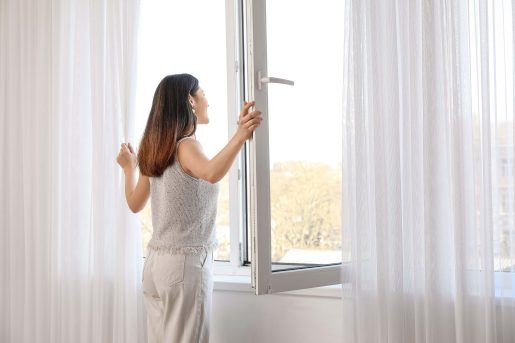 A practice known as “house burping” is gaining in popularity in the U.S. Stemming from a German tradition called “luften,” house burping involves opening the windows and doors daily to let stale air out and fresh air in. However, before you jump on this trend, Dr. David Corry, professor of medicine – immunology, allergy and rheumatology at Baylor College of Medicine, warns that you should consider the climate where you live.
“This is an idea that makes sense in the cooler climate of Central and Eastern Europe, where many houses are centuries old and were built without modern construction methods and HVAC systems,” Corry said. “Opening the windows and doors is a good way to clean out stale odors, particularly cooking-related odors and fumes in the kitchen, that can accumulate over time.”
In the hot and humid Houston climate, Corry does not recommend house burping. In fact, the practice could be dangerous to your health.
“On most summer days, Houston humidity exceeds 80%,” Corry said. “If you were to have 80% humidity in your house, mold would grow everywhere, and you would rapidly develop an untenable and unlivable situation.”
Well-maintained HVAC systems can keep the house cool and humidity levels under 50%. In addition to humidity, high levels of urban air pollution, ozone, pollen and other allergens also present a problem with house burping in a place like Houston.
“If you have allergic rhinitis, chronic sinusitis, asthma and other related disorders, these pollutants and allergens are especially bad to let in to your home,” Corry said.
How to clean the air in your house without burping
When faced with stale air, particulate issues or odor issues in your home, Corry said it’s best to address the problem directly.
“If you have a lot of cooking-related odors in the house, you have a poorly designed ventilation system. You may need a new hood or to consult an engineer about your stove ventilation to properly evacuate those odors,” Corry said.
High efficiency particulate accelerator, or HEPA, filters placed strategically around the house can help remove particles like pet hair and dander. Adding a charcoal filter can help address odors. Replacing old carpets will help remove dust mites and debris from the home.
Any water intrusions or obvious mold growth should be immediately remediated.
When house burping makes sense
Although humidity, pollution and pollen prevent Houstonians from opening the windows during the majority of the year, Corry said there are a few instances where house burping can be done safely.
“If the weather is pleasant – not hot and not humid – and there’s not a lot of pollen, mold or air pollution, which is maybe just two handfuls of days in the entire year, we can relish opening the windows and the screen door,” Corry said. “There’s nothing wrong with letting that good air circulate through your house. It may do nothing to improve your health, but it’s just a pleasant thing to do.”
It also may be beneficial to open the windows and air out the house when someone at home is sick.
“There is a large body of research on the transmission of infectious diseases that shows that respiratory viruses are transmitted through the air in tiny water-like particles,” Corry said. “They are released simply by breathing, and enhanced even more if you talk or cough, and they can persist in the air for days or even weeks. If you have a sick individual in the house, it is a good idea to rapidly exchange the air in the house. You may have to suffer a higher electricity bill if you’re doing this in the summer.”
Maintain a safe air quality
While trends like house burping draw attention, Corry said it’s important to consider how to maintain safe air quality in your environment throughout the year. That includes proper maintenance of your home and also where you work.
“You may have perfectly functioning air conditioning and HEPA filters at home, but if you go to work in an environment where there’s mold on the walls, you can develop sinusitis, asthma, allergies and more,” Corry said. “It’s especially important for people who live in hot and humid places like Southeast Texas to maintain the environment where you spend your time.”
By Molly Chiu